

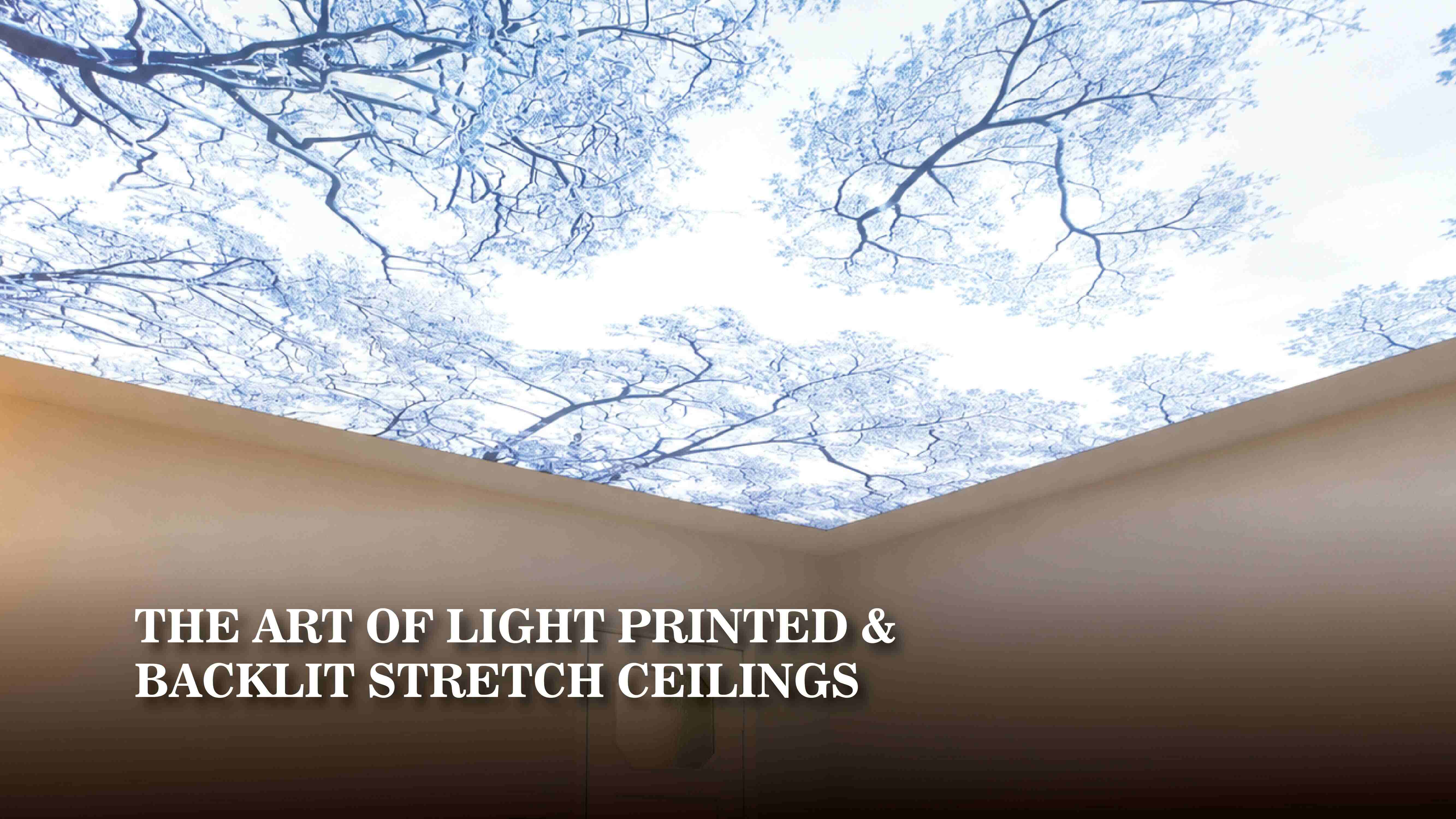
THE ART OF LIGHT
PRINTED AND BACKLIT STRETCH CEILINGS
There is a point in every interior project when the finishes are chosen, the furniture is placed and the lighting is almost complete. Yet sometimes the room still feels as though something is missing.
Often, that missing element is not another fixture, colour or piece of furniture.
It is the ceiling.
A printed stretch ceiling gives designers something conventional ceilings rarely offer: a large, uninterrupted surface that can carry an idea. It can hold an abstract pattern, artwork, a subtle texture or an image inspired by the character of the space. In hospitality, retail and commercial interiors, that surface can quietly reinforce the identity of a brand without adding another visual obstruction.
But printed design is only one possibility.
With a backlit stretch ceiling, the membrane itself becomes part of the lighting system. Instead of seeing individual light sources, the room can be filled with an even, diffused glow. The effect can resemble natural daylight, a softly illuminated skylight or an intentionally dramatic architectural surface.
Translucent stretch ceilings take the idea further. They allow designers to experiment with depth and illumination, particularly where the intention is to make light feel integrated rather than attached.
And then there is colour.
RGB and dynamic lighting can change the atmosphere of the same space without changing its physical structure. A wellness environment can remain soft and restrained during the day, while a hospitality or entertainment space can take on a completely different energy after dark.
What we have learned through experience is that these ceilings work best when technology remains in the background.
The aim is not to make visitors notice the lighting system.
It is to make them notice how the space feels.
That is where illuminated stretch ceilings become more than a decorative feature. They bring together surface, light, colour and architecture in one continuous element.
At Karma Design Stretch Ceiling Systems, we see the ceiling as an opportunity to shape atmosphere, not simply illuminate it.
Because sometimes the most memorable light in a room is the one you cannot quite see.