

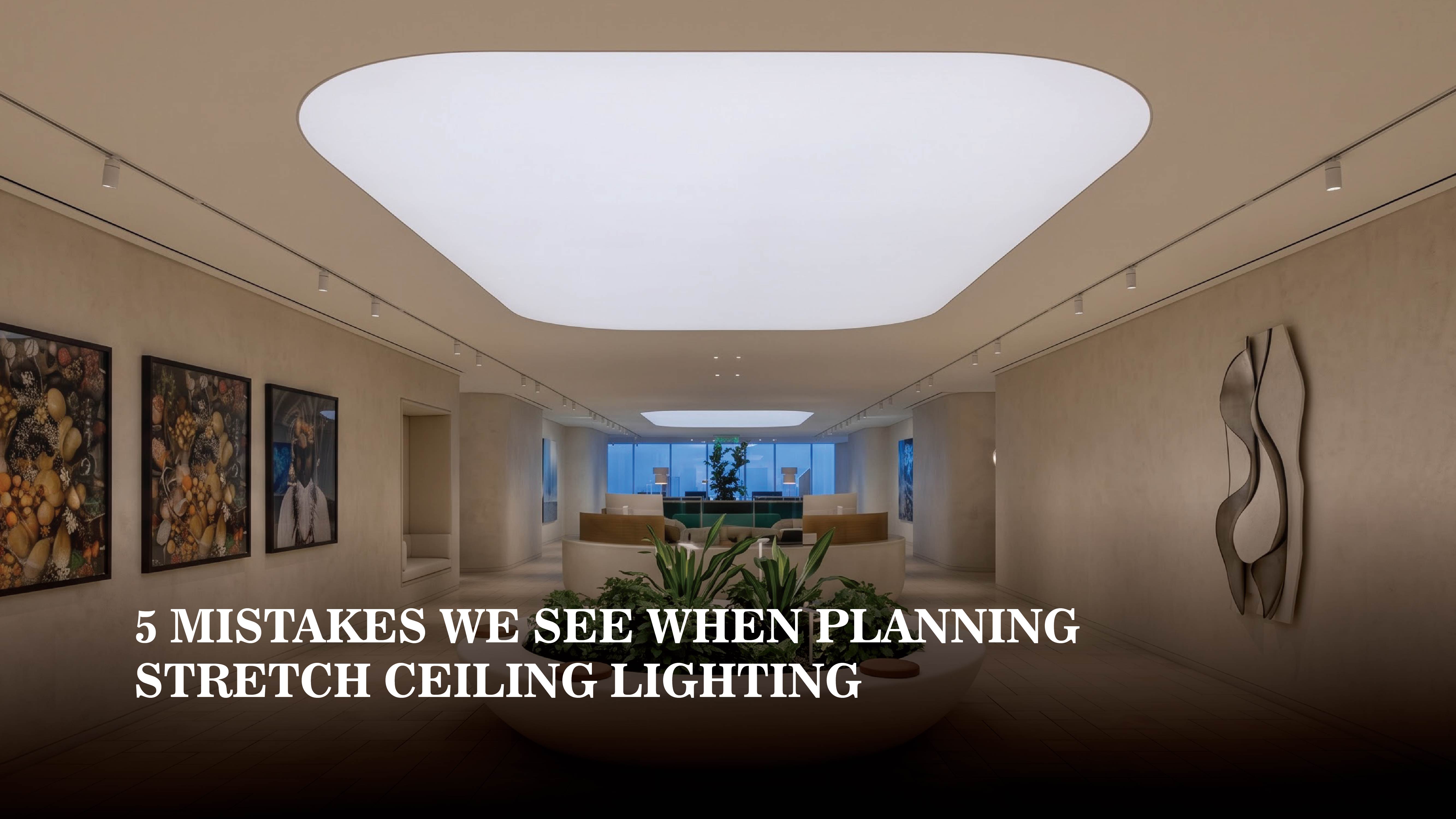
5 MISTAKES WE SEE WHEN PLANNING STRETCH CEILING LIGHTING
After years of working on interior projects, we have learned that lighting can make or break a stretch ceiling.
A well-planned lighting system can make a ceiling appear soft, seamless and almost weightless. Get the planning wrong, and the same ceiling can reveal hot spots, uneven illumination, visible shadows or a finish that looks very different from what was imagined in the design stage.
At Karma Design Stretch Ceiling Systems, we have seen beautiful ceiling concepts lose their impact because lighting was treated as something to be figured out later.
These are five mistakes we repeatedly see; and, more importantly, the lessons experience has taught us about avoiding them.
#1 CHOOSING THE LIGHT BEFORE CHOOSING THE CEILING
This sounds logical: select the lights, then install the ceiling.
In reality, it can create problems.
Different stretch ceiling materials interact with light differently. The distance between the light source and membrane, the type of light source and the desired level of diffusion all influence the final appearance.
We have seen projects where the lighting was finalised first, only for the team to discover later that the ceiling material did not produce the desired diffusion.
The result?
A lighting effect that looked excellent in a sample or drawing but didn’t feel the same across the actual ceiling.
WHAT EXPERIENCE HAS TAUGHT US
The ceiling material and lighting system should be considered together—not as two separate decisions.
Before finalising either, we look at the intended visual effect and how the light will behave through the selected material.
#2 TREATING A BACKLIT CEILING LIKE A NORMAL CEILING WITH LIGHTS BEHIND IT
One of the most common assumptions we encounter is that backlighting simply means placing lights above the membrane.
It is not quite that simple.
The distance between the light source and the stretch ceiling membrane matters. So does the arrangement and distribution of the light sources.
If the spacing is not properly considered, the individual light sources can become visible as bright spots or create variations across the ceiling.
Instead of the soft, continuous glow the designer imagined, the finished surface can look patchy.
WHAT WE HAVE LEARNED ON SITE
Backlighting needs planning before the ceiling is installed.
The lighting layout, source spacing, ceiling material and available cavity depth all need to work together.
A seamless-looking ceiling requires a lighting system that is planned to disappear behind it.
#3 LEAVING LIGHTING COORDINATION UNTIL THE LAST STAGE
This one can cause the most frustration on a live project.
By the time the stretch ceiling team arrives, electrical work may already be substantially complete. Then someone realises that a light needs to move, a driver needs access, a cable needs rerouting or a fitting needs a different position.
Now several teams have to coordinate around something that could have been resolved much earlier.
We have experienced enough project sites to know that late coordination rarely makes a project easier.
It can mean additional work, changes to other services and unnecessary pressure on the installation schedule.
OUR APPROACH
At Karma Design Stretch Ceiling Systems, we prefer to discuss lighting while the ceiling is still being coordinated.
We want to know:
- Where are the lights going?
- What type of lighting is being used?
- Where are the drivers located?
- What access will be required later?
- What services are sharing the ceiling cavity?
- What effect is the designer trying to achieve?
These may sound like small questions.
On site, they rarely are.
#4 DESIGNING FOR THE DRAWING INSTEAD OF THE ACTUAL SITE
A reflected ceiling plan can look perfect.
But buildings are not drawings.
Once installation begins, we may encounter beams, ducts, pipes, structural elements, electrical services or changes in ceiling levels that were not apparent during the initial design discussion.
This is particularly common during renovation or retrofit projects.
A lighting layout that works perfectly on paper may need to be adjusted when it meets the realities of the existing structure.
THE LESSON FROM EXPERIENCE
Always validate the lighting concept against the actual site conditions.
Before installation, we look at the available ceiling depth, existing services, access requirements and proposed light positions.
A few minutes of practical coordination early can save considerably more time later.
#5 FOCUSING ON BRIGHTNESS INSTEAD OF THE QUALITY OF LIGHT
This is perhaps the most subtle mistake.
People often ask:
“Will the ceiling be bright enough?”
But brightness is only part of the story.
A stretch ceiling can be bright and still feel uncomfortable, harsh or visually uneven.
For many projects, the goal is not maximum brightness. It is the right quality of illumination.
A hospitality space may need a soft, atmospheric glow.
A retail environment may need a more energetic lighting effect.
A residential space may need something warmer and calmer.
A corporate environment may call for controlled, comfortable illumination.
WHAT EXPERIENCE HAS TAUGHT US
We don’t look only at how much light reaches the room.
We also consider how the light is going to feel once the ceiling is finished.
Because people don’t experience a ceiling in technical specifications.
They experience it as part of a room.
#6 THE BEST LIGHTING IS THE LIGHTING YOU DON’T NOTICE
There is something interesting about a successful backlit stretch ceiling.
When it is done properly, people rarely ask:
“Where are the lights?”
They simply notice that the ceiling feels beautiful.
That is the point.
The lighting should support the architecture rather than compete with it. The membrane should appear evenly illuminated, the light sources should disappear from view, and the ceiling should feel like one continuous surface.
Achieving that effect requires more than installing lights above a membrane.
It requires coordination between material, lighting, distance, detailing, site conditions and installation.
That is where experience matters.
At Karma Design Stretch Ceiling Systems, we have worked through the practical realities of stretch ceiling projects across different spaces and applications. Our experience has taught us that the most impressive results often come from decisions that nobody sees once the project is finished.
And perhaps that is the real craft of good ceiling lighting:
When everything is planned correctly, the technology disappears—and the space simply feels right.